Infrared vs. Traditional Sauna: Which One Is Right for You?
Share
How each type works
The core difference comes down to how heat reaches your body.
Traditional Finnish saunas heat the air first. An electric or wood-fired heater warms a pile of dense volcanic stones; those stones then heat the cabin to somewhere between 150°F and 194°F. Your body heats from the outside in, through the surrounding air. The steam ritual, pouring water over the stones, is called löyly, and it immediately cranks up both the humidity and the perceived heat.
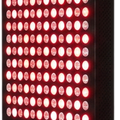
Infrared saunas skip the air entirely. Carbon or ceramic panels emit radiation that passes through the air and heats your body directly, the way sunlight warms your skin on a cool day. Because the heat goes into you rather than around you, the cabin only needs to reach 113°F to 150°F to produce a comparable sweat response. No steam, no löyly, no stones.
The longevity research gap
Here's something the infrared industry doesn't advertise: almost all the long-term health research on saunas was done with traditional Finnish saunas, not infrared.
The most cited study is the Kuopio Ischemic Heart Disease Risk Factor (KIHD) study, a 20-year follow-up of over 2,300 middle-aged Finnish men. Men who used a traditional sauna four to seven times per week had a 50% lower risk of fatal cardiovascular events, a 63% reduction in sudden cardiac death, and a 40% lower risk of dying from any cause compared to men who went once a week. Separate analysis from the same cohort linked frequent sauna use to lower rates of dementia and Alzheimer's.
None of that research used infrared.
That doesn't mean infrared does nothing. Both types raise core body temperature, increase heart rate, and trigger heat shock proteins, the molecular repair crew that protects cells from damage. A 30-minute infrared session at 130°F to 140°F raises core temperature enough to activate HSP70 and HSP90, proteins associated with cellular longevity. The science behind it is reasonable, just not yet proven at scale.
But whether the lower ambient temperatures of an infrared session produce the same long-term mortality outcomes as a 170°F+ Finnish sauna is genuinely unknown. The studies haven't been done. Anyone claiming certainty on that question is running ahead of the evidence.
Where infrared has the edge
For people managing cardiovascular disease
This is where infrared's clinical record stands apart. Waon therapy, a protocol developed specifically for chronic heart failure patients, uses a far-infrared sauna at 140°F for 15 minutes followed by 30 minutes resting wrapped in blankets. Multiple clinical trials confirm it lowers Brain Natriuretic Peptide (BNP) levels, improves endothelial function, and reduces pulmonary hypertension, without the respiratory stress that extreme heat causes. The traditional sauna literature is mostly about prevention in healthy people; Waon is about treatment in sick ones.
For chronic pain
Far-infrared penetration has real clinical support for musculoskeletal conditions. Pilot studies and systematic reviews show meaningful reductions in pain and stiffness for patients with rheumatoid arthritis, ankylosing spondylitis, and fibromyalgia, without worsening inflammatory activity.
For heat-sensitive users
If 190°F makes you feel like you can't breathe, infrared lets you get a vigorous sweat at 120°F to 140°F. The physiological response is real; the experience is more tolerable.
For home installation without a renovation
Most 1- to 3-person infrared units run on a standard 120V/15A or 20A household circuit. No electrician required, no floor drain. They warm up in 10 to 20 minutes and cost roughly $0.15 to $0.25 per session. Because they produce no steam, you can put one in a spare bedroom without structural changes.
Where traditional has the edge
Longevity and cardiovascular prevention
The KIHD data is specific about temperatures. Maximum heat shock protein activity and FOXO3 longevity gene activation appear to require ambient temperatures around 174°F. You can't get there in an infrared cabin. If you want to follow the Finnish protocol as closely as the research allows, traditional is the only option with actual population data behind it.
The löyly experience
Traditional saunas heat the entire space, so there's no wrong place to sit. Adding water to the stones creates a wave of steam that changes the sensory experience in ways a fixed infrared panel can't replicate. For experienced sauna users, this is often the whole point.
Outdoor use in cold climates
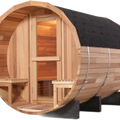
High-capacity heaters (4.5 kW to 9 kW) generate enough heat to push through freezing outside temperatures. A traditional barrel or cabin sauna in a snowy backyard works fine. Most infrared units aren't designed for that.
The intensity itself
For people who want extreme heat, infrared won't deliver it. A 190°F+ traditional sauna with good löyly is a different physical experience than a 140°F infrared session. They're genuinely different experiences. Which one you prefer probably matters as much as any of the clinical data.
Which one is right for you?
By health goal
| Goal or condition | Better choice | Why |
|---|---|---|
| Longevity and CVD prevention | Traditional | KIHD cohort data. Reaches temperatures associated with maximum heat shock protein activity. |
| Cardiovascular disease treatment (heart failure) | Infrared | Waon therapy trials. Effective at 140°F without cardiac or respiratory stress. |
| Chronic pain (arthritis, fibromyalgia) | Infrared | Far-infrared penetration reduces joint stiffness and pain without worsening inflammation. |
| Heat-sensitive users or beginners | Infrared | Full sweat response at 120°F to 140°F. Sessions are longer and more comfortable. |
| Maximum physiological intensity | Traditional | 190°F+ with steam is an experience infrared can't replicate. |
By installation situation
| Constraint | Better choice | What to know |
|---|---|---|
| Indoor, no renovations | Infrared | No moisture output. No drainage, barriers, or ventilation needed. |
| Standard household electrical only | Infrared | Most units plug into an existing 120V/15A or 20A circuit. |
| Outdoor or cold-climate installation | Traditional | High-capacity heaters handle freezing temperatures. |
| Willing to hardwire 240V | Traditional | Requires a licensed electrician, dedicated circuit, 30A to 50A breaker. |
| Lowest ongoing running cost | Infrared | Faster warm-up, lower wattage. Sessions run $0.15 to $0.25 each. |
Shopping for an infrared sauna
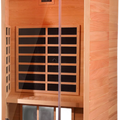
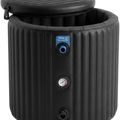
If this comparison pointed you toward infrared, a few practical notes for buying. Look for low-EMF carbon heaters and full-spectrum or near-infrared coverage. Our 1-person and 2-person extendable FAR infrared saunas use low-EMF hemlock construction, and the under-8mG Canadian hemlock model is built for daily recovery. If traditional suits you better, a cedar barrel sauna brings the classic high-heat session.